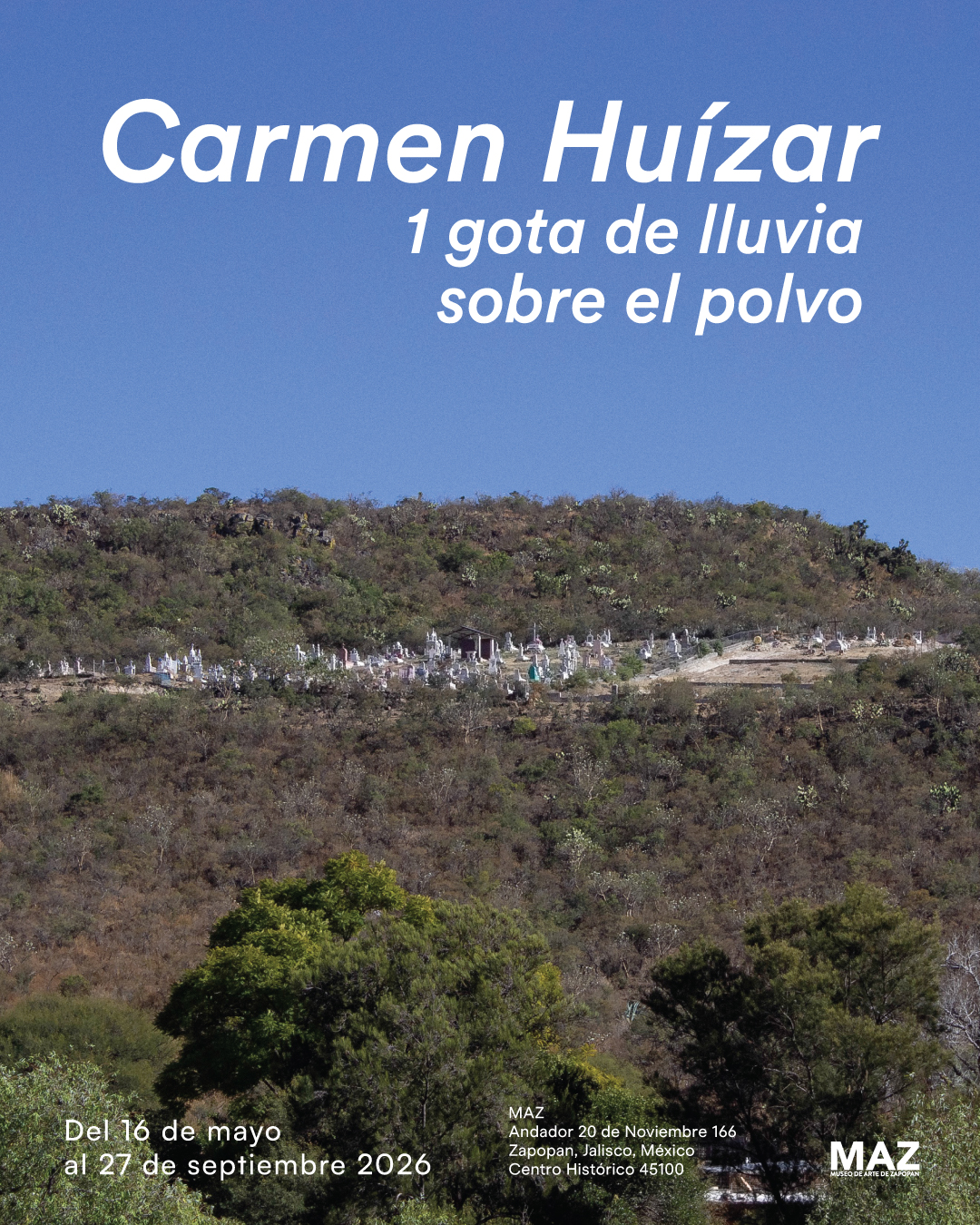
Carmen Huízar: 1 raindrop on the dust
From May 16 to September 27, 2026
Project Room
… a lot of people get scared when they hear they’re walking over dead people. Although we are all, more or less always, walking over a greater or lesser number of dead. There are many more dead people than living; it’s a simple truth: we all end up turned into earth.
— Mariana Enriquez, Somebody Is Walking on Your Grave: My Cemetery Journeys [trans. Megan McDowell]
All through history, cemeteries have served the social function of symbolically organizing relations between the living and the dead. Located far from city centers, banished to the margins for both health reasons and cultural considerations, they occupy a particular threshold: neither entirely integrated with everyday life nor completely separated from it.
It is from that threshold that this series of photographs by Carmen Huízar operates. The images are of village graveyards in rural communities in northern Jalisco, in which the mortuary constructions appear as barely perceptible presences, integrated into the landscape. The artist has recorded the same site at two different moments in the course of the year, thereby rendering visible the transformations of the territory wrought by the passage of time. The photographs capture liminal spaces, zones of contact where life and death coexist and are intertwined.
The project is also the result of a personal and emotional relationship with these spaces. On the one hand, the specifically private bond that connects Huízar to funeral rites as a family trade, which has led her to act as observer and participant in numerous burials. In Aliento [Breath] (2026), the artist probes the disproportion between different time scales, revealing human existence as something transitory and ephemeral: just a brief spark within the long duration of nature that exceeds it.
The territory of Jalisco contrasts with the idealized image of a landscape in which the seasons ―spring, summer, fall, and winter― succeed one another in an ordered and visible sequence, in accordance with a cultural conception derived from more temperate northern climes. In the north of Jalisco, the landscape is arid for most of the year, and driest of all in the spring. It is the summer rains that transform the vegetation and turn the surroundings green again.
These differences destabilize the perception of time, revealing it as a social construction that can be articulated in different ways, depending on the context. In these images, different temporalities overlap: human time, agricultural cycles, the rhythms of the earth itself. Although the seasons are shorter than a human life, an entire lifetime becomes all but imperceptible in comparison with the apparent eternity of a mountain. The imagined infinitude of the Latin American hinterland. The hills are eternal, or at least that is what we believe.
On the other hand, Huízar records signs and elements of both the urban and rural settings she traverses, later translating them into artistic media. In this displacement, local vernaculars are presented as a critical system of images. Using signs, the intervention Adentro/Afuera [Inside/Outside] (2017) transfers to the museum a series of phrases the artist has found outside of various churches. With nuance and insight, she shows how the patriarchal system informs the structures of different social institutions and is reproduced through them.
Rendered visible in 1 Raindrop in the Dust are the forms, both physical and social, whereby different temporalities, spaces, and structures organize the body, the landscape, and life itself.