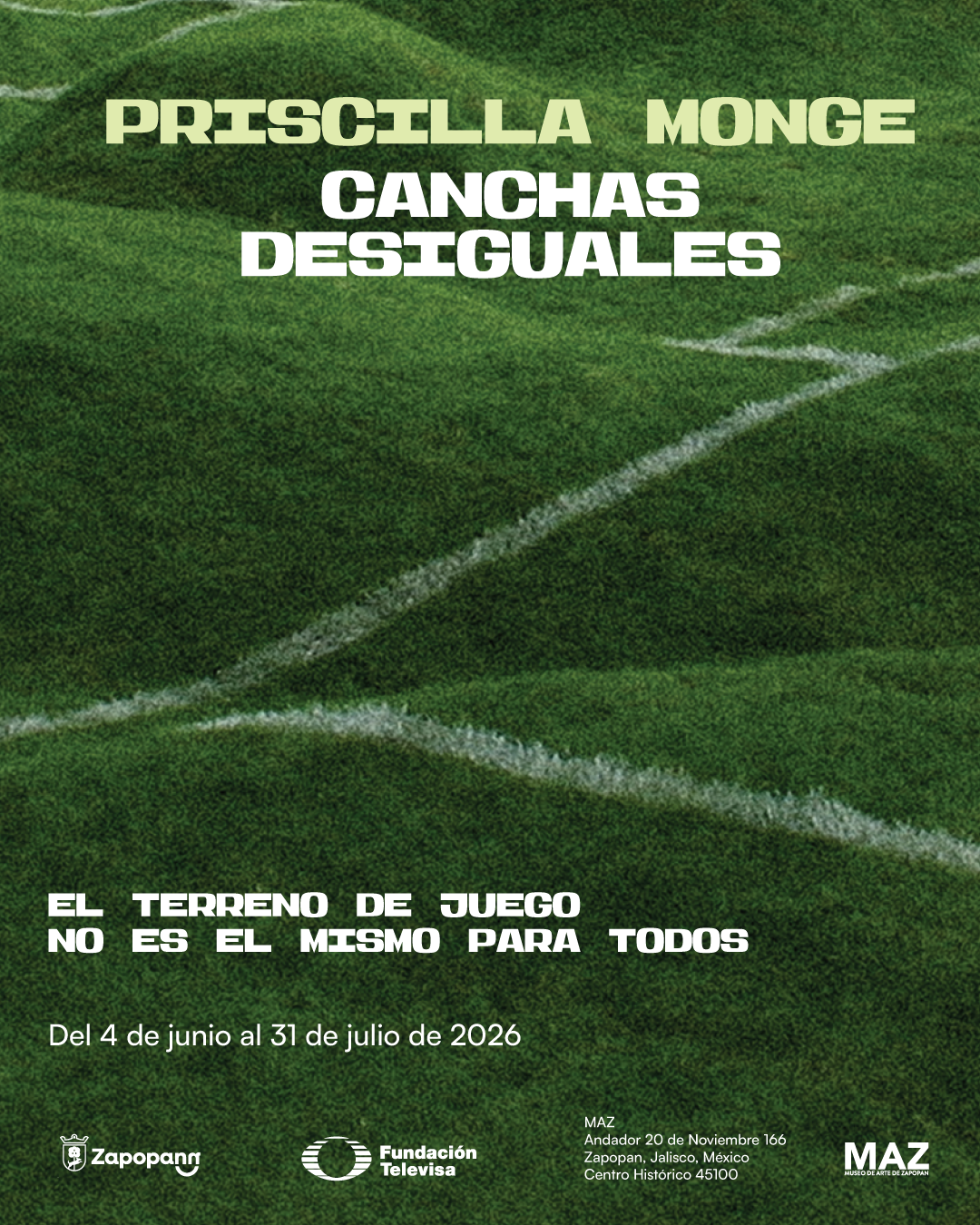
Priscilla Monge: Unlevel Playing Fields
Priscilla Monge
From June 4 to July 31, 2026
A Collaboration Fundación Televisa
MAZ Patio
The idea of the soccer field came from various places. The first was geographical nostalgia. During a long stay in Belgium, the first thing I missed was the complete absence of mountains. In Costa Rica we live in the midst of an extremely varied topography: lots of mountains, some valleys, and a considerable number of volcanoes for such a small country.
The idea began to take shape toward the end of the 1990s, but it was only in 2004 that it was presented for the first time: a little indoor playing field in an exhibition entitled Nostalgia of the Body/Nostalgia del cuerpo. The title is not the result of chance. Geography is related in many ways to the body, and the body in turn to geography.
When I conceived the piece, I was in a foreign place. When one is in that situation, many familiar forms undergo changes and it is necessary to invent new ways of living. A soccer field is a territory that can be recognized almost anywhere in the world. Most people understand the space, know how to enter it and to read it, if only intuitively. That is why I thought it was a fairly democratic space, at least in that sense: everyone can relate to it.
The original title of the work ―Heterotopia― comes from there: creating a space within another space, a text within another text. But however familiar the place, in order to play in it the rules have to be reformulated. It is a game that is not entirely fair, like life itself. The playing field is not level, and neither is life. On this occasion, the work has been transformed into Unlevel Playing Fields. The new title points to a more direct reality: we don’t all have the same opportunities or face the same obstacles. The terrain on which we play is never neutral.
Every time this work is presented, in some way it overruns the conventional limits of a work of art and turns into an event. The playing field is no longer simply an object or an installation, activating relations, encounters, and temporary forms of community.
In the past, a version of the work was presented at Place Stalingrad, in Paris, very close to an immigrant neighborhood. This context rendered visible another dimension of the piece: these spaces serve to build community, however briefly. For a moment, the shared terrain allows different people to enter into the same situation, negotiate each other’s movements, and participate in a common game.
Now, Unlevel Playing Fields will be presented in Mexico in June of 2026, in a context where the issue of inequality acquires particular relevance. Mexico is a country beset by enormous social and economic differences, and the game of soccer, which is often thought of as a common language, also reflects these tensions. Even the World Cup is marked by this paradox: while the games attract the interest of millions of people, the experience of seeing a match live is largely reserved to those whose economic circumstances make that possible.
In Mexico, the work is to be presented in three different cities: Monterrey, Guadalajara, and Mexico City. This circulation is not without significance. Each one of these cities has a different social, economic, and urban configuration, and these differences will inevitably modify the way the playing field is activated and relates to those who occupy it. The same work will not be the same in each place. The unlevel terrain will find other bodies, other audiences, other ways of coexisting, and other tensions. Thus, the three playing fields do not function as identical repetitions, but rather as variations on the same question: How do we play, how do we participate, and how do we share a space when the conditions of the game are never the same?
In this context, the opportunity for children and adults to enter the field is fundamental. The work is not limited to being observed: it is activated by the bodies that occupy it, play on it, and put it in tension. Here, art no longer occupies a contemplative distance and becomes a shared experience, accessible and direct. The playing field allows people of different ages and contexts to relate to a complex idea ―that of inequality― not only in terms of thought, but also through bodies, balance, effort, play, and laughter.
In this sense, the work dialogues not only with the physical form of an inclined or irregular playing field, but also with the social structures that determine who can enter, who can play, who can watch from up close, and who must stay outside. The playing field becomes the concrete image of a broader reality: the terrain is never equally distributed.
Unlevel Playing Fields speaks of geography, of the body, of the invisible rules that determine how we move in the world, and of the possibility of encountering one another, if only for an instant, on a shared terrain.
Priscilla Monge